
Trade weaponization has fundamentally altered the geopolitical landscape by converting economic instruments into tools of state power. The United States and Europe employ financial measures to influence outcomes well beyond their own borders. This dynamic creates vulnerabilities for states such as India, as global power is increasingly exercised through economic chokepoints rather than direct military confrontation. The central argument is that economic coercion now exerts a greater influence on international relations than traditional military force.
Trade Weaponization: 4 Brutal Forces Driving Coercion
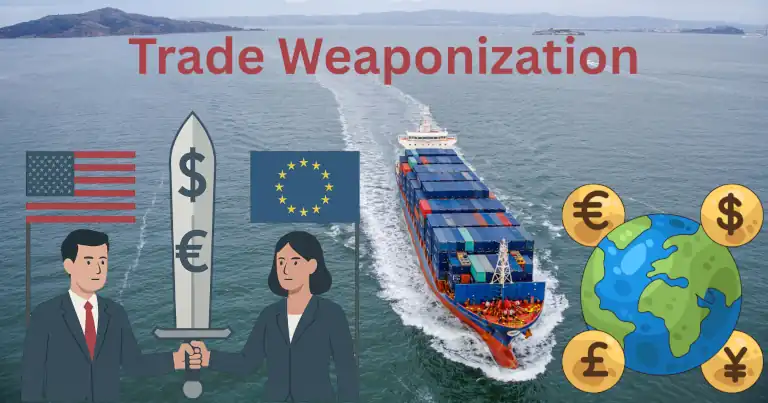
Trade weaponization visualized through U.S.–EU economic pressure, global currency leverage, and the strategic use of trade routes as coercive tools.
- The Decoder
- Decision Echoes
Table of Contents
The Ruthless Logic Behind Trade Weaponization
Trade weaponization now underpins contemporary power dynamics, substituting military conflict with economic pressure. States restrict access to markets, currencies, and supply chains rather than deploying armed forces. This form of coercion is subtle yet highly destructive, compelling compliance through financial vulnerability rather than physical force. Understanding current geopolitics requires a thorough examination of the mechanisms and impacts of trade weaponization.
Why Economic Coercion Replaced Military Force
Powerful states increasingly achieve strategic objectives through economic coercion rather than direct military engagement. Sanctions, export controls, and financial restrictions exert pressure on adversaries while often avoiding significant public scrutiny. Trade weaponization is effective because it inflicts substantial harm without triggering widespread international backlash. This approach constitutes a form of warfare conducted through legal and regulatory frameworks.
How Dollar Dominance Enables Global Control
The dominance of the U.S. dollar is central to the effectiveness of trade weaponization. The majority of global transactions are processed through U.S. jurisdiction, granting Washington significant leverage over international commerce. Financial institutions, insurers, and logistics companies comply promptly with U.S. directives due to the severe repercussions of non-compliance. Even states that oppose U.S. sanctions are compelled to comply, as their private sectors cannot afford the risks of defiance.
The Human Cost of Economic Siege
The primary victims of trade weaponization are civilians rather than governments. In countries such as Iran, Venezuela, and Cuba, sanctions have resulted in shortages of medicine and food, the deterioration of infrastructure, and the erosion of personal savings. Hospitals experience supply deficits, industries face collapse, and trade weaponization functions as a form of collective punishment, inflicting widespread suffering to induce political change.
Europe’s Dual Role: Enforcer and Target
Europe actively reinforces U.S. sanctions and participates in economic coercion, yet expresses surprise when it becomes a target of such measures. The continent’s dependence on American financial systems and technology is evident. Europe’s experience demonstrates that trade weaponization can affect all states, including close allies.
Why Europe Aligns With U.S. Sanctions
Europe aligns with U.S. sanctions primarily because its financial and corporate sectors are unwilling to jeopardize access to the U.S. market. European banks and insurers are deeply integrated into the dollar-based financial system, rendering compliance with U.S. measures effectively mandatory. Even when political interests diverge, economic imperatives compel Europe to support U.S. trade weaponization. This alignment is driven by structural dependency rather than ideological agreement.
Europe’s Shock When Trade Weaponization Hits Home
Europe’s confidence in its partnership with the United States diminishes when trade weaponization targets European interests. The imposition of sanctions related to Nord Stream 2 marked a significant turning point, underscoring Washington’s ability to penalize European companies for pursuing independent energy strategies. The Airbus–Boeing dispute and the Inflation Reduction Act further highlighted Europe’s vulnerability. The energy crisis following sanctions on Russia demonstrated that Europe remains susceptible to the adverse effects of economic coercion.
Structural Weakness Behind Europe’s Vulnerability
Europe’s vulnerability stems from its limited economic sovereignty. The euro does not function as a global enforcement currency, and European payment systems are subject to U.S. jurisdiction. Key sectors such as logistics, insurance, and technology remain dependent on U.S. firms. Political fragmentation within the European Union impedes unified resistance. Consequently, Europe alternates between acting as an enforcer and as a victim, depending on U.S. policy priorities.
India’s Calibrated Paralysis
India adopts a strategy of calibrated paralysis in response to trade weaponization, characterized by caution and flexibility. Rather than openly challenging or fully aligning with U.S. sanctions, India evaluates each situation on a case-by-case basis. This approach is intentional yet exposes vulnerabilities, as it seeks to safeguard India’s interests while minimizing the risk of economic retaliation.
Why India Cannot Defy U.S. Economic Power
India recognizes that defying U.S. sanctions would likely result in secondary sanctions, restricted access to technology, and financial market instability. The U.S. dollar is integral to India’s trade and foreign reserves, and global supply chains depend on adherence to Western regulations. Within this context, India’s adoption of calibrated paralysis is a rational response. The avoidance of confrontation is driven by the magnitude of structural risks rather than by weakness.
Selective Engagement With Sanctioned States
Despite its cautious approach, India engages selectively with sanctioned states. In the case of Iran, India reduced oil imports in response to U.S. pressure but maintained diplomatic relations. With Russia, India increased energy purchases despite international criticism, while refraining from overt defiance. India also sustains discreet engagement with Venezuela and Cuba. This balanced strategy serves to protect India’s interests and prevent direct conflict with the United States.
Long‑Term Risks of Strategic Ambiguity
While calibrated paralysis provides India with short-term flexibility, it does not enhance long-term resilience. India remains vulnerable to trade weaponization due to the absence of alternative payment systems, independent logistics networks, and regional trade frameworks that could shield it from external coercion. Without a comprehensive doctrine of economic sovereignty, India risks being unprepared if U.S. interests shift. The prevalence of trade weaponization underscores India’s economic fragility and highlights the necessity for structural reforms.
Global Echoes of U.S. and European Coercion
Trade weaponization generates ripple effects that transform global markets, alliances, and political behavior. Economic coercion has become the primary instrument of statecraft, fundamentally altering the geopolitical landscape. The resulting consequences extend beyond the intended targets, increasing the unpredictability of the global order.
How Trade Weaponization Reconfigures Alliances
States targeted by trade weaponization actively pursue new partnerships. Iran, Russia, Venezuela, and Cuba have strengthened relations with China, Turkey, and the Gulf states. Even neutral countries diversify their international relationships to mitigate exposure. These developments accelerate the fragmentation of the global order and foster the creation of parallel financial, logistics, and technology systems.
Market Disruptions and Supply Chain Shockwaves
Economic coercion significantly disrupts global markets. Sanctions and export controls alter supply chain routes, elevate shipping and insurance costs, and contribute to volatility in energy and commodity markets. These disruptions extend beyond the primary targets, impacting neutral economies and consumers. Inflation, shortages, and price increases globalize the effects of localized coercion.
The Erosion of Trust in Western Institutions
The intensification of trade weaponization undermines trust in Western institutions. In response, states are developing alternative payment networks, regional trade blocs, and non-Western financial instruments. As a result, the global economy is becoming increasingly fragmented and unpredictable. The erosion of trust is driving a shift toward competing economic spheres.
The Uncomfortable Truth Behind Economic Coercion
Trade weaponization ultimately exposes a truth that rarely appears in official statements: economic pressure is designed to hurt societies long before it ever touches political elites. The architecture of sanctions, fuel blockades, and financial restrictions is presented as “targeted,” yet its impact is overwhelmingly social. When access to fuel, medicine, food, or currency is restricted, it is not presidents or ministers who stand in queues, but ordinary citizens. This is the built‑in collateral damage of economic coercion, and it is neither accidental nor unforeseen.
“We will continue to apply maximum pressure until Iran changes its behavior.”
Trump Administration 1.0 and Trump Administration 2.0
This statement captures the core philosophy behind modern sanctions: apply sufficient economic pressure to compel the target state to shift course. While the language frames pressure as a tool aimed at governments, the practical impact of such maximum‑pressure campaigns falls overwhelmingly on ordinary citizens. Fuel shortages, inflation, medical disruptions, and supply‑chain breakdowns become the lived reality for populations with no role in geopolitical decision‑making. In this sense, trade weaponization functions less as a precise instrument of diplomacy and more as a broad economic shock that treats civilian hardship as an acceptable collateral effect.
Recent global reactions reinforce this uncomfortable reality. In February 2026, UN experts condemned a U.S. executive order imposing a fuel blockade on Cuba, warning that such measures “directly endanger civilian life” and violate humanitarian principles. Their statement is a rare acknowledgment from an international body that economic coercion is not a sterile policy tool but a mechanism that reshapes daily life in sanctioned societies. Source: https://www.ohchr.org/en/press-releases/2026/02/un-experts-condemn-us-executive-order-imposing-fuel-blockade-cuba
This is the trade weaponization the world has built: a system in which financial plumbing, legal frameworks, and institutional dependencies can be turned into instruments of pressure at any moment. The U.S. and Europe may justify these measures as necessary for global stability, but the lived reality in sanctioned states tells a different story, the one of scarcity, inflation, and systemic breakdown. As more countries recognise this imbalance, the global order is shifting toward parallel systems, alternative payment networks, and new alliances formed not out of ideology but out of necessity.
The uncomfortable truth is that trade weaponization will continue to shape the world not through dramatic headlines, but through the quiet, grinding pressure felt in the daily lives of millions. Until global institutions confront the moral cost of economic coercion, the burden of geopolitical conflict will remain on the shoulders of ordinary people, the very individuals who have the least power to influence the decisions made in their name.