
Strategic Latency: 5 Silent Moves That Undermine Afghanistan
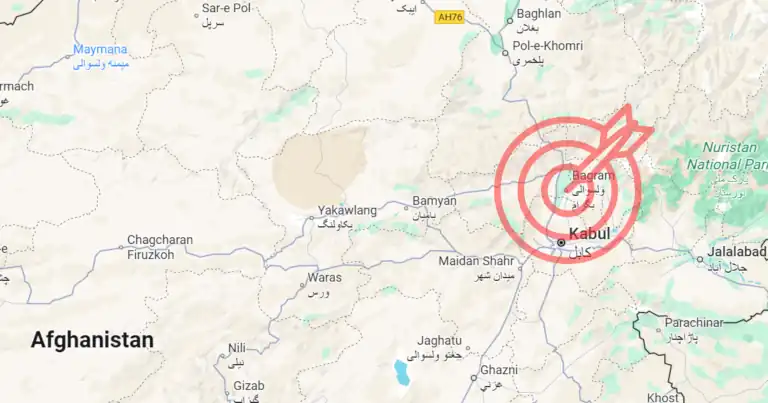
This map, sourced from Google Maps, highlights Afghanistan’s central corridor, Kabul, Baghlan, and surrounding regions, now emerging as focal points of strategic latency. The red target symbol marks areas of geopolitical recursion, proxy influence, and humanitarian strain.
- The Decoder
- Latency Logs
- June 17, 2026
Table of Contents
Afghanistan’s recent retaliation against Pakistan marks more than a border clash. It revives a Cold War doctrine once shaped by proxy alliances and strategic latency. As guerrilla tactics resurface against conventional power, the very playbook Pakistan once leveraged now turns inward, exposing the recursive nature of geopolitical design.
The Playbook Returns: Tactical Echoes from the Proxy Era
Afghanistan’s counteroffensive against Pakistan revives a buried doctrine, where asymmetric tactics once deployed through proxies now resurface as sovereign assertion. This shift doesn’t just reflect battlefield adaptation; it exposes the strategic latency that has lingered since the Cold War, now weaponised in reverse.
From Proxy Fire to Sovereign Retaliation
Pakistan’s airstrikes have triggered more than retaliation. They have activated a long-buried latency in Afghanistan’s tactical memory. What once flowed through proxy channels now returns as direct assertion. Guerrilla mastery, once outsourced, regains its original roots. This latency isn’t just a reversal, but it is a doctrinal boomerang. Afghanistan’s silence, shaped by terrain and time, now speaks in calibrated bursts, exposing how deferred strategy becomes institutional fragility.
Strategic Latency as Institutional Drift
Strategic latency doesn’t always erupt, but it accumulates over time. In Afghanistan’s case, decades of deferred sovereignty, proxy conditioning, and tactical outsourcing have calcified into institutional drift. The recent border retaliation isn’t just a flashpoint. It is a symptom of long-standing latency now surfacing as doctrinal inversion.
Latency by Design: The Cost of Tactical Outsourcing
Pakistan’s Cold War-era strategy relied on exporting guerrilla warfare into Afghan terrain, embedding latency as a tool of influence. However, strategic latency, once externalised, rarely remains contained. Afghanistan’s current posture reflects how outsourced tactics eventually return, reconfigured, autonomous, and unbound by original intent.
Terrain as Memory: Latency in the Landscape
Afghanistan’s geography isn’t just a battlefield, but it is a mnemonic device. Valleys, ridges, and passes have endured decades of asymmetric pressure. Strategic latency lives in these contours, shaping how retaliation unfolds. The terrain doesn’t forget. It recalibrates, turning silence into sovereign assertion.
Strategic Latency as Abandonment Doctrine
The U.S. withdrawal from Afghanistan wasn’t just a tactical exit; it was a strategic latency event disguised as closure. Initiated under one administration and executed by another, the decision prioritised domestic cost over geopolitical continuity. In doing so, it left Afghanistan suspended under a regime with no UN recognition, exposing collaborators and eroding institutional trust. Strategic latency here manifests not as silence, but as abandonment, where deferred responsibility mutates into regional instability.
Proxy Re-entry: Pakistan as a Strategic Instrument
Pakistan’s recent strikes on Afghan soil reflect more than counterterrorism. They signal proxy re-entry orchestrated by the United States. While the U.S. formally exited Afghanistan, its strategic latency persists through calibrated influence over Pakistan’s military posture. The renewed interest in Bagram Airbase, once a cornerstone of U.S. operations, directly undermines China’s regional calculus. For Beijing, a stable, Pakistan-aligned Taliban regime secures Belt and Road continuity and buffers concerns in Xinjiang. A U.S. foothold at Bagram threatens that equilibrium, introducing surveillance, unpredictability, and diplomatic friction. Pakistan’s actions, while framed as anti-terror operations, serve a dual purpose: appeasing U.S. strategic interests without derailing its China corridor. In this layered game, Afghanistan becomes the terrain, not the beneficiary of foreign latency.
Collateral Silence: The Cost to Afghan Civilians
In this latency-driven chessboard, the Afghan population bears the brunt of the consequences. Women, already excluded from public life, now represent 50% of a degraded civic existence. Collaborators who once aligned themselves with U.S. efforts face exposure, while their livelihoods erode under a regime lacking global legitimacy. If the U.S. seeks strategic re-entry via Bagram, it must first confront the humanitarian latency it left behind. As far as AI Strategy Decoded is concerned, India’s stance remains clear: no recognition, and no engagement, while women lead a degraded life.
Strategic Latency as Diplomatic Silence
Afghanistan’s current leadership remains unrecognised at the UN, suspended in a state of legitimacy. This silence isn’t accidental, but it is strategic. The absence of recognition allows global powers to manoeuvre without formal engagement, preserving plausible deniability while exerting influence.
India’s Abstention: Editorial Sovereignty Over Recognition
India’s refusal to recognise the Taliban regime isn’t just diplomatic, but principled. As long as Afghan women remain excluded from civic life, recognition would signal complicity. The United Nations, too, has withheld formal recognition, leaving Afghanistan suspended in a state of legitimacy. Strategic latency here becomes a moral stance, not a procedural delay, where silence preserves editorial sovereignty and shields against legitimising gender apartheid.
UN Vacuum: Latency in Global Legitimacy
The UN’s inability to seat a recognised Afghan envoy reflects a deeper latency, where institutional silence becomes a tool of containment. This vacuum allows strategic actors to operate in ambiguity, shaping outcomes without accountability.
The Bagram Paradox: Latency vs Leverage
Retaking Bagram may offer tactical leverage, but it reactivates strategic latency, reviving Cold War-era fault lines and triggering regional pushback. China’s Belt and Road calculus, Iran’s border sensitivities, and Russia’s Eurasian buffer all converge here. The U.S. must weigh latency against long-term legitimacy.
Conclusion: Strategic Latency as Editorial Reckoning
Afghanistan’s current condition is not merely the result of tactical missteps but the cumulative effect of strategic latency across decades. Proxy recursion, diplomatic silence, and humanitarian neglect have converged into a doctrine of abandonment. If the United States seeks re-entry, whether through Bagram or proxy influence, it must first reckon with the lives it left suspended, especially the women now erased from civic life.
As Al Jazeera reports, regional powers view the retaking of Bagram as a provocation, one that disrupts China’s strategic calculus and reactivates Cold War fault lines. Strategic latency, once a tool of influence, now demands accountability. Recognition without reform is complicity. Silence without sovereignty is editorial failure.
Where Latency Becomes a Modern Capability Failure
The structural delays that shaped Afghanistan’s trajectory mirror the broader patterns examined in ‘AI Systems: 4 Hidden Threats Derailing Power Moves‘, where friction, institutional drag, and slow decision cycles quietly erode national momentum. Viewed together, these analyses reveal a consistent truth: latency, whether geopolitical or technical, reshapes outcomes long before leaders recognize the shift, and by the time the effects surface, the strategic cost is already locked in.