
Signal Mismatch 8: The Dangerous Myth of Pakistan’s Oil
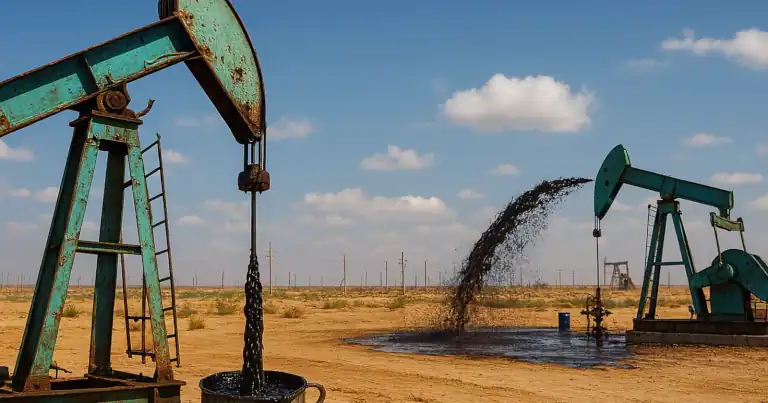
One side struggles to extract a bucket of oil. The other side overflows without acknowledgment. A visual metaphor for signal mismatch, where claimed scarcity masks silent abundance.
- The Decoder
- Signal Failures
- June 12, 2026
Trump’s announcement of an oil partnership with Pakistan reverberated across South Asia, but the signal doesn’t match the source. Pakistan’s proven reserves are modest, its silence strategic, and its role in regional energy flows more symbolic than sovereign. If there were truly vast oil reserves beneath Pakistan’s soil, the British Empire would have known it long before waging major wars in the Middle East and North Africa. Their imperial cartography was precise, and their appetite for oil was insatiable. The absence of discovery then speaks louder than any claim now.
This article decodes the merchanting logic behind Iran’s shadow supply, India’s quiet autonomy, and the geopolitical recursion that turns noise into latency. Welcome to Signal Mismatch 8, where editorial clarity emerges from collapsed claims.
Trump’s Oil Rhetoric: Strategic Theatre or Tactical Bluff?
Trump enters the South Asian table with a dramatic raise, an oil deal with Pakistan, framed as a game-changer. He flashes the “massive reserves” card, hints at exports to India, and threatens tariffs for Russian imports. The crowd leans in. But Pakistan doesn’t match the bet. No press conference, no geological data, no pipeline blueprints. Just silence.
The cards on the table don’t add up. Pakistan’s proven reserves are modest. India keeps importing Russian oil. Iran watches from the shadows. And Trump’s loudest move might be a bluff, designed not to win the pot, but to reshuffle the board.
This section deals out the players, the stakes, and the strategic misreads behind the announcement. Because in this game, the loudest signal might be the weakest hand.
The Announcement: A Loud Raise with No Cards
Trump’s declaration of an oil partnership with Pakistan came with dramatic flair, “massive reserves,” “energy corridor,” and “regional reset.” But the announcement lacked supporting data, geological surveys, or even a joint press release. Pakistan remained silent. No ministers echoed the claim. No one mapped the pipelines. It was a loud outburst in a poker game, and the other player didn’t even look up.
This rhetorical move wasn’t about oil, but it was about leverage. By invoking Pakistan, Trump inserted himself into India’s energy calculus, hoping to disrupt its Russian oil imports and reassert American influence in South Asia.
The Tell: Pakistan’s Silence and Strategic Debt
In poker, silence is a tell. Pakistan’s lack of response suggests either strategic discomfort or deliberate ambiguity. With modest reserves and no recent discoveries, Pakistan has little to offer in terms of actual oil. But it does offer geography and debt.
Pakistan owes billions to the US and its allies. By remaining silent, it avoids committing to a deal it cannot deliver, while still allowing Trump to use its name as a geopolitical chip. The silence isn’t passive, but tactical. It keeps options open, avoids scrutiny, and provides shadow corridors to operate beneath the surface.
Pakistan’s Proven Reserves: Silence Over Substance
If Pakistan truly held vast oil reserves, the British Empire would have drilled them dry long before waging wars in Iraq, Iran, and Libya. Their imperial cartography was ruthless, their resource mapping precise. Yet Pakistan remained a transit zone, not a treasure chest. Today, its proven reserves stand at just 353.5 million barrels, which is barely enough to cover two years of domestic demand.
This silence isn’t accidental. It’s strategic. Pakistan avoids confirming or denying Trump’s claims, allowing speculation to swirl while maintaining plausible deniability. No new discoveries. No seismic surveys. Just echoes of past disappointments, like ExxonMobil’s failed offshore drill in 2019. The louder the claim, the more profound the silence. And in that silence, editorial clarity emerges.
Imperial Cartography: What the British did not find
The British Empire drilled through Egypt, fortified the Suez Canal, and mapped every inch of Mesopotamia in search of oil. But Pakistan? It remained a transit zone. No major fields. No extraction infrastructure. Meanwhile, the Germans fought bitterly over Libya’s desert corridors, Tobruk, Benghazi, and the oil routes to Tripoli. If Pakistan held strategic reserves, it would’ve been contested long before Rommel’s tanks rolled across North Africa.
The absence of imperial interest isn’t oversight, but it is evidence. Pakistan’s geological silence echoes louder than any modern claim. Trump’s announcement isn’t a rediscovery but a rhetorical mirage.
Strategic Ambiguity: Pakistan’s Editorial Silence
Pakistan’s silence following Trump’s oil announcement isn’t just diplomatic, but it is editorial. By neither confirming nor denying the claim, Pakistan avoids scrutiny while remaining geopolitically useful. This ambiguity allows speculative corridors to operate: Iranian oil merchanted through Pakistan, repackaged for silent buyers. It’s a strategy of latency, where silence becomes leverage, and editorial restraint becomes geopolitical currency.
Signal Mismatch in Iran, Pakistan, and India Corridor
Beneath Trump’s oil theatrics lies a quieter corridor, the one that does not appear on official maps, but pulses with strategic recursion. Iran, sanctioned and sidelined, shares a porous border with Pakistan. Smuggling routes are old, debt is mounting, and silence is profitable. Pakistan, lacking reserves, may be playing transit, not producer, thus allowing Iranian oil to flow eastward under editorial cover.
India, meanwhile, continues importing Russian oil despite tariff penalties. If Iranian oil flows through Pakistan, India benefits without formalizing trade with Tehran. It’s a merchanting loop: Iran supplies, Pakistan repackages, India consumes, and the US watches, unable to intercept a corridor built on silence.
This section decodes the signal mismatch between claimed partnerships and actual flows, revealing how editorial ambiguity becomes geopolitical infrastructure.
Iran’s Shadow Supply: Sanctions Without Silence
Iran’s oil doesn’t stop flowing just because sanctions say it should. Decades of embargo have only refined its shadow logistics with overland tankers, ship-to-ship transfers, and reflagged cargoes. The Pakistan-Iran border, porous and poorly monitored, offers a discreet corridor. With Pakistan’s mounting debt and strategic need for relevance, acting as a silent transit state becomes both plausible and profitable. No official contracts. No public declarations. Just oil that changes names, flags, and destinations, without ever changing its source.
India’s Silent Benefit: Energy Without Entanglement
India continues to import discounted Russian oil, resisting U.S. pressure with calibrated defiance. But if Iranian oil flows through Pakistan, India gains a second shadow stream, without formalizing ties to Tehran or violating sanctions directly. It’s a diplomatic sleight of hand: energy security without entanglement. The corridor remains unofficial, the trade deniable, and the benefits tangible. In this loop, silence isn’t complicity, but it is insulation.
India’s Energy Autonomy: Quiet Resistance to Tariff Pressure
India isn’t just navigating tariffs, but it is absorbing them. As of August 2025, the U.S. has imposed a 50% tariff on Indian goods, including a 25% penalty specifically for Russian oil imports. Yet India hasn’t blinked. It continues to import discounted Russian crude, citing energy security and consumer protection. This isn’t defiance, but autonomy. A calibrated resistance that absorbs cost, reroutes supply chains, and signals that strategic independence trumps transactional pressure.
While Trump frames the tariffs as leverage, India treats them as noise. The Reserve Bank’s inflation models remain stable. Refiners adjust blends. And behind the scenes, India quietly explores alternative corridors, including shadow flows from Iran. The result? A signal mismatch between U.S. pressure and Indian policy. A mismatch that reveals more about global energy asymmetry than any press release.
For a detailed breakdown of the tariff structure and its geopolitical implications, see this Times of India analysis on U.S. sanctions and India’s Russian oil trade.
Domestic Calculus: Inflation Models and Strategic Blends
India’s energy autonomy isn’t just diplomatic, but mathematical. The Reserve Bank’s inflation models remain stable despite tariff shocks, and refiners quietly adjust blends to absorb cost. This internal recalibration creates a signal mismatch between external pressure and domestic response. While the U.S. expects disruption, India delivers continuity. The numbers don’t lie, and neither does the silence.
Tariff Absorption: Editorial Insulation Against External Noise
India’s decision to absorb tariffs rather than retaliate is a form of editorial insulation. It reframes economic pressure as strategic latency. By continuing Russian imports and exploring shadow flows from Iran, India creates a signal mismatch between its public posture and private logistics. The tariffs are loud, but India’s response is quiet, calculated, and sovereign.
Editorial Metaphor: Pipeline Ghosts and Strategic Echoes
Every claim about oil in Pakistan feels like a ghost pipeline, mapped in rhetoric, invisible in reality. The corridors are drawn in press releases, not in soil. The reserves are cited without surveys. And the partnerships are announced without signatures. These are pipeline ghosts, editorial apparitions that haunt geopolitical discourse.
The echoes are louder than the flows. Trump’s announcement reverberates across South Asia, but the actual energy movement is silent, recursive, and off-grid. This is the essence of a signal mismatch: where the loudest voices mask the quietest truths, and editorial clarity emerges only when the noise fades.
This section reframes the entire article as a diagnostic metaphor, where pipelines become symbols, silence becomes infrastructure, and mismatches become editorial tools.
Ghost Infrastructure: Rhetoric Without Reservoirs
Pipeline announcements without surveys. Reserve claims without geology. Partnerships without signatures. These are the ghosts of infrastructure, editorial apparitions that haunt press releases and policy briefings. They exist in rhetoric, not in soil. The mismatch between what is said and what is mapped is not just technical, but editorial. A signal mismatch where the loudest claims dissolve under diagnostic scrutiny.
"Political language is designed to make lies sound truthful and murder respectable, and to give an appearance of solidity to pure wind.”
George Orwell
Echo Logic: Editorial Diagnosis of Strategic Noise
Trump’s oil announcement echoes across South Asia, but the actual flows are silent. Iran’s shadow supply, India’s tariff absorption, Pakistan’s ambiguity, none of it matches the official signal. The editorial diagnosis reveals a signal mismatch between geopolitical theatre and logistical reality. The louder the echo, the emptier the pipeline. And in that emptiness, editorial clarity emerges.
Editorial Closeout: Where Mismatch Becomes Method
The oil isn’t in Pakistan. The signal isn’t in the announcement. The corridor isn’t in the pipeline. What remains is a signal mismatch, between rhetoric and reserves, between tariffs and autonomy, between maps and movement. This mismatch isn’t a flaw, but it is a method. A diagnostic tool for decoding geopolitical theatre.
Trump’s announcement was loud. Pakistan’s silence was louder. India’s autonomy was quietest of all. And in that silence, the editorial truth emerged, not in barrels, but in mismatches. Not in pipelines, but in echoes. Signal Mismatch 8 doesn’t resolve the noise, but it archives it. With timestamped restraint, metaphorical clarity, and sovereign editorial rhythm.
Sanction Layers: Legal Isolation vs Editorial Enforcement
Iran is sanctioned by the United Nations, giving its isolation a multilateral legal scaffold. Russia, by contrast, is sanctioned only by the United States and European Union, not by the UN. Yet the U.S. applies pressure on India and China as if Russia were globally banned. This creates a signal mismatch between legal legitimacy and editorial enforcement.
The mismatch isn’t just diplomatic; rather, it is diagnostic. It reveals how unilateral sanctions are editorialised into global expectations, even when there is no legal basis. India’s continued Russian imports, despite U.S. tariffs, highlight this asymmetry: the louder the enforcement, the thinner the legitimacy.
Sanction Legitimacy: Iran’s Isolation vs Russia’s Veto
Iran’s sanctions carry UN legitimacy and are backed by a multilateral consensus. Its isolation is codified, surveilled, and institutionally scaffolded. Russia, by contrast, holds veto power within the UN Security Council. Therefore, it is structurally impossible to impose global sanctions on Russia. Yet the U.S. imposes unilateral sanctions and expects global compliance, creating a signal mismatch between legal authority and editorial enforcement.
This signal mismatch isn’t just diplomatic; rather, it is infrastructural. Iran is legally isolated but logistically active. Russia is lawfully unbound but editorially pressured. The louder the enforcement, the thinner the legitimacy. And in that asymmetry, editorial clarity emerges.
For readers interested in how hidden failures emerge inside complex systems long before they become visible, the analysis in Silent Zone: 4 Brutal Insights into Hidden Failures explores the internal dynamics that cause organizations to miss early warning signals. Taken together, these pieces outline how misalignment, whether in data, perception, or system behavior, creates cascading risks that are easy to overlook and costly to correct.