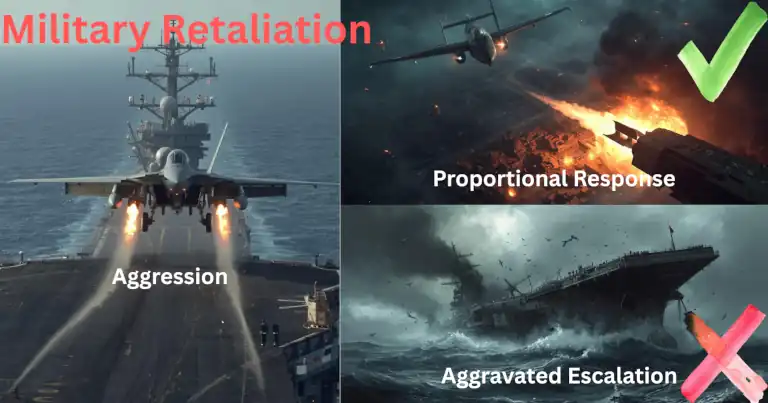
Military Retaliation Under UNSC Article 51 for Hostile Aggression
UNSC Article 51 strictly limits military retaliation to self-defence when clear legal thresholds of aggression are crossed. Within Decision Echoes, we examine how states interpret threats, justify the use of force, and respond under this clause. They must balance proportionality, escalation control, and international legitimacy.
Disclaimer: At AI Strategy Decoded, we do not support aggression, pre-emptive force, or deterrence based only on guesses. We reject any framework that allows violence without proven, legal reasons.
Decision Triggers Under UNSC Article 51
Before any state can act under the self‑defence clause, it must cross a series of tightly defined decision thresholds. These thresholds ensure that force is not justified by speculation, misinterpretation, or political convenience. In Decision Echoes, we examine how these triggers shape lawful responses and constrain the path toward authorised action.
Military Retaliation as a Legally Activated Pathway
The option of military retaliation becomes available only when an armed attack is verified, attributed, and recognised as meeting the legal threshold under UNSC Article 51. This pathway is not automatic; it requires a structured assessment of necessity, proportionality, and the strategic consequences of a forceful response. States must demonstrate that no alternative measures could neutralise the threat or restore security.
Determining When Hostile Aggression Meets the Armed Attack Standard
Not all hostile acts qualify as an “armed attack.” States must interpret scale, severity, and intent through a legal lens that avoids opportunistic escalation. This evaluation includes assessing whether the aggression threatens territorial integrity, civilian safety, or critical infrastructure. The high threshold is designed to prevent states from invoking self‑defence in response to ambiguous or low‑intensity incidents.
Attribution, Verification, and the Burden of Proof Before Action
Attribution is the most sensitive trigger for decision-making. A state must establish who conducted the attack, how it was executed, and whether the evidence meets international standards of credibility. Verification processes such as technical forensics, intelligence corroboration, and diplomatic confirmation serve as safeguards against miscalculation. Without verified attribution, any response risks undermining legitimacy and destabilising the broader security environment.
Proportionality and Escalation Control in State Responses
Once a state recognises that an armed attack has occurred, the next challenge is determining how to respond without triggering an uncontrolled escalation spiral. Proportionality is not merely a legal requirement; it is a strategic discipline that shapes how force is applied, how signals are interpreted, and how legitimacy is preserved under UNSC Article 51.
Assessing the Scale and Scope of a Lawful Response
Proportionality requires states to match the scale of their response to the severity of the aggression suffered. This assessment includes evaluating the damage inflicted, the threat of further attacks, and the operational environment in which force may be used. Even when military retaliation is legally available, states must ensure that their actions do not exceed what is necessary to neutralise the threat and restore security.
Preventing Escalation Through Controlled Use of Force
Escalation control is a deliberate effort to prevent a conflict from expanding beyond its initial boundaries. States must consider how their actions will be interpreted by adversaries, allies, and neutral observers. A response that is too forceful risks widening the conflict; a response that is too limited may fail to deter further aggression. The balance between these extremes defines the credibility and stability of the state’s strategic posture.
Signalling Intent and Maintaining International Legitimacy
Every action taken under UNSC Article 51 sends a signal. States must communicate that their response is defensive, necessary, and temporary. Clear signalling helps prevent misinterpretation and reinforces the legal basis for action. Legitimacy is strengthened when states demonstrate restraint, transparency, and adherence to international norms, ensuring that their response is seen as corrective rather than opportunistic.
Escalation Dynamics and Strategic Signalling
Once a state initiates a response under UNSC Article 51, the conflict enters a phase where actions and interpretations become tightly interlinked. Escalation dynamics determine whether the situation stabilises, intensifies, or spirals into broader confrontation. Strategic signalling plays a decisive role in shaping how adversaries, allies, and international observers interpret each move.
How States Manage the Escalation Ladder After Force Is Used
The escalation ladder is not a linear sequence but a fluid spectrum of choices. After force is applied, states must reassess intent, capability, and the adversary’s likely next steps. Even when military retaliation is justified, each subsequent action must be calibrated to avoid triggering disproportionate countermeasures. Misreading the ladder can lead to rapid, unintended escalation.
Strategic Signalling to Shape Perceptions and Limit Miscalculation
Signalling is a deliberate communication strategy that clarifies intent and reduces ambiguity. States use diplomatic statements, military posture, and controlled transparency to demonstrate that their actions are defensive and limited. Effective signalling helps prevent adversaries from assuming broader intentions, thereby reducing the risk of miscalculation and maintaining the legitimacy of the response.
Managing Adversary Perceptions to Prevent Conflict Expansion
Perception management is central to escalation control. States must anticipate how their actions will be interpreted by the adversary and adjust their posture accordingly. A response perceived as excessive may provoke further aggression, while a response perceived as weak may invite additional challenges. Balancing these perceptions is essential to stabilising the conflict environment and preventing expansion.
When Military Retaliation Risks Become an Aggravated Escalation
Even when military retaliation is legally justified, the choice of target determines whether the response remains proportional. For example, if a state suffers a limited bombing run launched from an aircraft carrier, sinking the carrier would almost certainly be considered an act of aggravated escalation. An aircraft carrier is not merely a weapons platform; it is a floating city with over 5,000 sailors, massive capital investment, and strategic significance. Destroying it would exceed the scale of the initial attack and risk triggering a far wider conflict. Proportionality requires states to calibrate their response to the actual harm suffered, not to the symbolic value of the adversary’s assets.
Evaluating Target Value, Human Cost, and Strategic Impact
Proportionality is not measured solely by the type of weapon used but by the consequences of the chosen target. A response that destroys critical infrastructure, endangers thousands of personnel, or cripples national capabilities may be interpreted as punitive rather than corrective. States must therefore assess the human cost, strategic value, and long‑term implications of each target. The goal is to neutralise the threat without escalating the conflict into a broader confrontation.
How Escalation Perceptions Shape International Legitimacy
International legitimacy depends on how observers interpret the scale and intent of a state’s response. A proportional response reinforces the narrative of lawful self‑defence, while an escalated response risks diplomatic isolation and condemnation. States must therefore consider not only the operational impact of their response but also the political and legal signals it sends. Escalation perceptions can influence alliances, global opinion, and the stability of the conflict environment.
Case Studies: Proportionality, Escalation, and State Responses
This section integrates two real‑world examples of military retaliation:
- Operation Sindhoor.
- Current USA–Iran standoff.
Operation Sindhoor: India’s Proportional Response to the Pahalgam Massacre
Operation Sindhoor illustrates how a state can apply force proportionally in response to extreme provocation. After the Pahalgam massacre, carried out by Pakistan‑sheltered terrorists, India executed a calibrated response by striking terror camps inside Pakistan using air‑launched missiles. This action targeted the perpetrators directly, avoided civilian infrastructure, and remained within the boundaries of proportionality.
Pakistan’s subsequent actions, however, crossed into the realm of aggravated escalation. By striking both civilian and military targets inside India, Pakistan expanded the conflict beyond the original trigger. India’s counter‑response was precision BrahMos strikes on Pakistan Air Force bases, thus restoring proportionality by targeting military assets directly linked to the escalation. The standoff de‑escalated only after the DGMOs of both countries negotiated a ceasefire through the established hotline.
The USA–Iran Standoff: Deterrence, Warnings, and Global Observation
The current USA–Iran standoff demonstrates how deterrence signalling can shape global expectations. The United States has issued warnings based on allegations of Iranian involvement in regional attacks, while Iran has responded with explicit statements about the scale of military retaliation it would undertake if attacked. Iran’s exercises in the Strait of Hormuz serve as both a deterrent and a signal of readiness, raising the stakes for any miscalculation. The world is watching closely, aware that even a limited strike could trigger a chain of escalatory responses with global consequences.
Legal Boundaries and International Oversight in Armed Responses
Even when a state believes its actions fall within the right of self‑defence, the international system imposes legal boundaries that shape how force may be used. These boundaries ensure that military retaliation remains accountable, transparent, and subject to scrutiny. Under UNSC Article 51, states must justify their actions, demonstrate necessity, and show that their response aligns with international norms rather than political expediency.
Reporting Obligations and the Legal Burden Under Article 51
Any state engaging in force under Article 51 must immediately report its actions to the UN Security Council. This requirement ensures that military retaliation is not conducted in secrecy or justified retroactively. The report must outline the nature of the attack, the evidence supporting attribution, and the rationale for the response. Failure to report undermines legitimacy and invites diplomatic pressure, signalling that the state may be acting outside the accepted legal framework.
How International Oversight Shapes the Limits of Military Action
International oversight acts as a stabilising force. States know that their actions will be evaluated by allies, adversaries, and neutral observers. This scrutiny discourages excessive or punitive responses and reinforces proportionality. When a state exceeds the boundaries of lawful self‑defence, it risks sanctions, loss of diplomatic support, and reputational damage. Oversight, therefore, becomes a strategic constraint that influences how military retaliation is planned and executed.
The Role of Global Norms in Preventing Escalatory Misuse of Force
Global norms, such as the prohibition on targeting civilians, the requirement to discriminate, and the expectation of restraint, shape how states apply force. These norms are not merely moral guidelines; they are operational constraints that define acceptable behaviour. A state that violates these norms risks being labelled an aggressor, even if it initially acted in self‑defence. Maintaining adherence to these norms strengthens the credibility of military retaliation and reinforces the state’s position within the international system.
Strategic Reflections on Retaliation, Restraint, and Global Stability
Military decisions do not occur in isolation. Each act of force generates echoes, whether legal, political, or strategic, that shape the broader security environment. Understanding these echoes is essential for evaluating how states navigate the tension between deterrence and escalation. When military retaliation is applied with precision, restraint, and legal clarity, it reinforces stability. When it is excessive or miscalculated, it accelerates instability and widens conflict.
In the contemporary landscape, where regional crises can rapidly become global flashpoints, the discipline behind state responses matters more than ever. The examples of Operation Sindhoor and the USA–Iran standoff demonstrate how proportionality, signalling, and legal framing influence outcomes. They also show how quickly misinterpretation can transform a limited confrontation into a broader crisis.
As the world watches these dynamics unfold, the central question remains: can states use force to restore security without igniting a larger conflict? The answer depends on how carefully they interpret threats, calibrate responses, and uphold the principles embedded in UNSC Article 51. In Decision Echoes, these choices reveal not only the logic of state behaviour but the fragile balance that underpins global stability.