
Frozen assets are no longer just a sanctions tool; instead, they have become a fault line in the global financial system. Europe’s decision to immobilise Russian reserves, and the fact that some policymakers even toyed with the idea of confiscating not just the interest, but the entire asset base, has triggered a wave of concern far beyond Brussels. From India repatriating gold to Nagpur, Delhi, and Mumbai, to Gulf and ASEAN states exploring custody options in Dubai and Singapore, the message is clear: trust in Western financial neutrality is eroding. This article breaks down the five critical risks undermining Europe.
Frozen Assets: 5 Critical Risks Undermining Europe
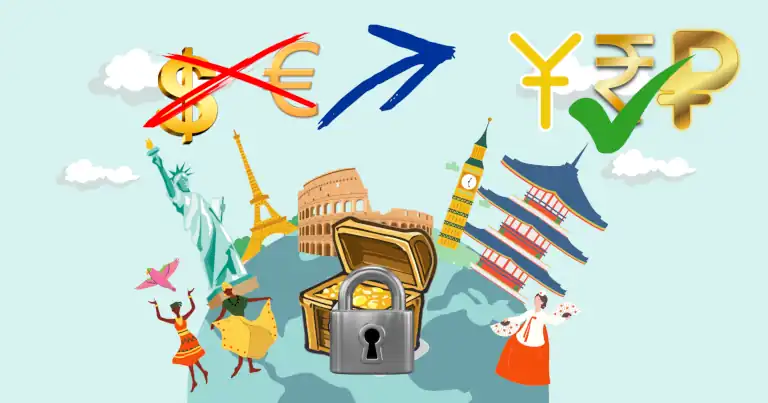
Frozen assets are redrawing global financial lines as trust erodes, reserves and influence pivot Eastward.
- The Decoder
- Decision Echoes
Risk 1: The Collapse of Trust in Western Custodianship
Europe’s handling of frozen assets has triggered the most fundamental concern any reserve‑holding nation can have: whether its wealth is safe in Western hands. The moment policymakers openly entertained the idea of confiscating not just the interest, but the entire asset base, the perception of neutrality fractured. Although the outright seizure did not proceed, and Belgium later opposed it, they damaged their trust.
The End of Political Neutrality in Reserve Custody
For decades, Western custodianship rested on a simple assumption:
“Your reserves are safe regardless of geopolitics.”
That assumption no longer holds. The Russian precedent has shown that reserves can be immobilised, restricted, or debated as potential sources of funding for political objectives. Nations across the Global South now view Western custody as conditional rather than guaranteed.
The Global South’s Quiet Reassessment
Countries that are neither aligned with Russia nor hostile to Europe are now reassessing their exposure to Europe. These countries include:
- India
- Saudi Arabia
- UAE
- Indonesia
- Brazil
- South Africa
- ASEAN middle powers
These states are not reacting ideologically; instead, they are responding logistically. If Europe can freeze and appropriate reserves once, it can do so again.
Gold Repatriation as the First Line of Defense
Gold is the most politically sensitive reserve asset and the first to move when trust erodes.
- India has already repatriated significant volumes to Nagpur, with additional flexibility via Delhi and Mumbai.
- Some gold may remain in London or Switzerland for operational reasons, such as rapid pledging for current‑account support.
- But the strategic direction is unmistakable: reduce exposure to Western vaults.
New Custody Hubs: Dubai and Singapore
As trust shifts, so does geography. Dubai and Singapore are emerging as neutral, commercially reliable alternatives for gold and reserve custody. They offer:
- political non‑alignment
- strong commercial law
- no sanctions‑driven unpredictability
- proximity to Asian and Gulf financial flows
This move is not symbolic; rather, it is a structural rebalancing of where nations perceive it to be safe to store their wealth.
Risk 2: Accelerated Reserve Flight to Non‑Western Systems
The debate around frozen assets has done more than unsettle custodial trust. It has accelerated a more profound structural shift: the quiet but deliberate movement of reserves, payment flows, and settlement activity toward non‑Western financial systems. Nations that once relied almost exclusively on the dollar‑euro architecture are now building parallel channels designed to reduce exposure to Western policy decisions. The mere willingness of European policymakers to consider confiscating or appropriating immobilised reserves has reinforced the perception that the existing system is no longer politically neutral.
The Rise of Alternative Payment Mechanisms
One of the clearest consequences of this shift is the rapid expansion of non‑Western payment networks. Countries across Asia, the Gulf, Africa, and Latin America are increasingly adopting or integrating with systems that bypass Western intermediaries.
Examples include:
Examples include:
- China’s CIPS, which offers a yuan‑based alternative to SWIFT for cross‑border settlements.
- India’s UPI‑linked cross‑border corridors are now expanding into the Gulf and Southeast Asia.
- Russia’s SPFS, which, despite its limited reach, is being connected to Asian and Eurasian partners.
- Bilateral settlement channels between Gulf states and Asian economies.
These systems are not yet replacements for the dollar‑centric order, but they are becoming credible hedges. The logic is simple: if frozen assets can be immobilised once, then payment flows routed through Western systems can also be disrupted.
Currency Diversification as a Strategic Shield
Alongside new payment rails, countries are diversifying the currencies they use for trade, reserves, and settlement. This action is not ideological; rather, it is defensive. Key trends include:
- Greater use of local currencies in bilateral trade (India–UAE, China–Brazil, Russia–China)
- Yuan‑denominated commodity contracts, especially in energy
- Rupee‑based settlement windows for regional partners
- BRICS discussions on shared settlement frameworks, not a single currency, but interoperable systems
The goal is not to replace the dollar overnight but to reduce vulnerability to Western decisions that could immobilise reserves or disrupt flows.
The Quiet Rewiring of Global Financial Plumbing
What makes this risk particularly significant is its irreversibility. Once countries invest in alternative rails, build currency buffers, and establish bilateral settlement agreements, they do not revert to the old system even if tensions ease. The architecture becomes permanent.
Frozen assets may have triggered the shift, but the momentum now comes from a broader recognition: no nation wants its economic stability to depend on a system in which political decisions in Brussels or Washington can reshape access overnight.
Russia’s Legal Case as a Global Signal, Not a Legal Strategy
Even though Russia is unlikely to win the case it has filed in European courts, it is pursuing the litigation for a different purpose: to demonstrate to the rest of the world how Western judicial systems handle disputes involving frozen assets. The point is not the verdict, but the process. By forcing the courts to rule on the legality of immobilising sovereign reserves, Moscow is creating a public record that many countries in the Global South are watching closely. If the outcome appears predetermined or politically aligned, it reinforces the perception that any nation caught in a similar predicament would face the same structural bias. This perception alone accelerates the shift toward non‑Western payment systems and reserve frameworks.
Risk 3: Legal Precedent That Undermines Sovereign Immunity
The debate around frozen assets has created a legal fault line that extends far beyond Russia. By immobilising sovereign reserves and openly discussing whether to confiscate or appropriate them, Europe has unintentionally weakened one of the core pillars of international finance: sovereign immunity. Even if they frame the measures as exceptional, the precedent they establish is anything but. Once a legal boundary is crossed, even in extraordinary circumstances, it becomes part of the global playbook.
A Precedent That Europe Cannot Contain
European policymakers insist that the immobilisation of Russian reserves is a one‑off response to a unique situation. But global markets do not interpret legal signals in isolation. They interpret patterns.
The moment Europe demonstrated that sovereign reserves could be frozen, restricted, or debated as potential sources of funding, it created a template that future governments could reuse. Nations across the Global South now view this as a structural shift, a sign that sovereign immunity is no longer absolute when geopolitical tensions rise.
Courts as Extensions of Policy, Not Neutral Arbiters
Russia’s legal challenge in European courts may fail. The EU’s legal architecture, combined with the political context, makes the outcome predictable. But Moscow’s objective is not victory; rather, it is exposure.
By pursuing the case, Russia is creating a public demonstration of how Western courts handle disputes involving frozen assets. Russia seeks to demonstrate that when geopolitics collides with the law, political alignment can shape the judicial process. Countries watching this closely include:
- India
- Saudi Arabia
- UAE
- Indonesia
- Brazil
- South Africa
These states are not evaluating the merits of Russia’s claim. They are assessing the predictability of Western courts, knowing that one day Europe will entangle their assets in a dispute.
The Erosion of Legal Neutrality
The most damaging consequence is not the immobilisation itself, but the perception that legal neutrality has limits. If sovereign nations regard the European Courts as extensions of their own policy rather than independent arbiters, then sovereign immunity becomes conditional. And once immunity is conditional, nations begin to redesign their financial strategies accordingly.
The legal dimension of frozen assets destabilises the system for precisely this reason. It signals that the protections once considered foundational, the right to hold reserves abroad without political interference, can be overridden by collective decisions in Brussels or coordinated actions across Western institutions.
A Long‑Tail Risk With Global Implications
Legal precedents do not fade. They accumulate.
Even if Europe never repeats this action, the precedent remains available to future governments, future crises, and future political coalitions. That alone is enough to push countries toward alternative custody arrangements, non‑Western payment systems, and diversified legal jurisdictions.
Frozen assets may have triggered the debate, but the legal consequences will echo for decades, thus reshaping how nations assess risk, allocate reserves, and choose where to place their trust.
Risk 4: Long‑Term Damage to Europe’s Custody and Clearing Business
The debate over frozen assets is not only reshaping geopolitics; instead, it is reshaping the commercial foundations of Europe’s financial sector. Custody, clearing, and settlement have long been Europe’s quiet strengths, generating stable revenue and reinforcing its position as a trusted global intermediary. But once Europe demonstrated that sovereign reserves could be immobilised, and even discussed as potential sources for confiscation or appropriation, the commercial calculus changed.
Clients do not wait for legal outcomes; they respond to risk signals.
A Commercial Model Built on Predictability
Europe’s financial infrastructure: Euroclear, Clearstream, the Bank of England, and national central banks, has thrived because global clients believed that political decisions would not impair their assets. That belief is now eroding.
The moment sovereign reserves became entangled in political strategy, Europe’s custody business inherited a reputational liability that no compliance framework can fully offset.
This precedent is not about Russia. It is about every future client asking a simple question: “If political winds shift, will my assets remain accessible?”
A Legal Doctrine That Cuts Both Ways
Sovereign immunity is central to this debate. The doctrine exists to prevent one state from sitting in judgment over another, a principle deeply rooted in international law.
“A sovereign’s freedom from judicial control does not arise from the will of the courts… all exemptions from territorial jurisdiction must be derived from the consent of the sovereign.”
Justice Stanley Forman Reed
This quote, drawn from National City Bank of New York v. Republic of China, underscores a truth many countries are now revisiting: Custody is not just a financial service; instead, it is a legal relationship built on consent, neutrality, and trust.
When Europe immobilised Russian reserves, it acted within its legal framework. But globally, the perception was different: the action blurred the line between judicial restraint and political alignment.
For readers who want a deeper legal background, the Wikipedia overview of sovereign immunity provides a helpful primer: https://en.wikipedia.org/wiki/Sovereign_immunity
Competitors Are Already Capitalizing
Financial centres outside the West, such as Dubai, Singapore, and Shanghai, are positioning themselves as politically neutral custody hubs. Their pitch is simple:
No sanctions exposure, no geopolitical entanglement, no precedent of asset immobilisation.
This commitment is not theoretical. Banks, sovereign funds, and commodity traders are already shifting:
- settlement flows
- custody mandates
- collateral management
- repo operations
- sovereign wealth allocations
Once these flows move, they rarely return. Financial plumbing is sticky.
Europe Risks Losing Its Most Valuable Intangible Asset
The greatest danger is not immediate outflows, but the erosion of Europe’s reputation as a safe, rules‑based custodian.
- Custody is a trust business.
- Clearing is a confidence business.
- Settlement is a neutral business.
When neutrality is at issue, the business model is weakened.
Frozen assets may have triggered the shift, but Brussels, Frankfurt, Luxembourg, and London, not Moscow, will feel the long‑term commercial consequences.
Risk 5: Fragmentation of the Global Financial Order
The debate over frozen assets has accelerated a trend that was already underway: the slow, deliberate fragmentation of the global financial order. For decades, the world operated on a shared assumption — that Western financial infrastructure, Western legal systems, and Western custodianship formed the neutral backbone of global commerce. That assumption is now breaking apart. The immobilization of Russian reserves and the willingness to consider confiscation or appropriation have pushed many countries to rethink not just where they store their wealth but also which financial architecture they want to belong to.
A System That No Longer Feels Universal
The dollar‑euro system once functioned as a universal platform. Even countries with political disagreements relied on it because it was predictable, rules‑based, and insulated from geopolitical swings. Frozen assets changed that perception.
Nations now see a system in which political lenses restrict access, immobilise reserves, and distort interpretations of legal protections. The result is a quiet but decisive shift: countries are no longer treating the Western system as the default. They are treating it as one option among several, and increasingly, not the safest one.
Parallel Financial Ecosystems Are Emerging
The fragmentation is not theoretical. It is already visible in the creation of parallel ecosystems:
- Non-Western payment networks
- Regional clearing houses
- Bilateral settlement corridors
- Commodity contracts priced outside the dollar
- Currency-swap lines that bypass Western banks
- Sovereign‑wealth cooperation frameworks across Asia and the Gulf
These systems are not yet replacements for the Western order, but they are becoming functional alternatives. And once other options exist, fragmentation becomes irreversible.
The Strategic Logic Behind Fragmentation
Countries are not building parallel systems because they expect conflict. They are building them because they expect uncertainty. Frozen assets demonstrated that geopolitical alignment can reshape access to reserves, settlement channels, and legal protections. The logical response is diversification, not just of currencies, but of entire financial pathways.
Geopolitical alignment is the reason why fragmentation is accelerating: every new payment rail, every bilateral settlement agreement, every regional clearing hub reduces dependence on Western infrastructure. And every reduction in dependence reduces Europe’s leverage, influence, and commercial relevance.
Europe Risks Becoming a Regional, Not Global, Financial Power
The long‑term danger is not that Europe loses Russian business. It is that Europe loses global business.
If the world concludes that Western custodianship is conditional, Western courts are aligned, and the West can weaponise its infrastructure, then the global financial order will not collapse; it will split.
One system will remain Western. The other will be a distributed network across Asia, the Gulf, and parts of Africa and Latin America.
In such a world, Europe becomes a regional financial power rather than a global one.
Frozen assets may have been the trigger, but fragmentation is the consequence, and once fragmentation begins, it rarely reverses.