
India stands at a turning point. The AI Talent Exodus, once seen as a harmless global migration, now threatens to limit India’s rise as a technology power. For decades, we celebrated remittances and ignored the strategic cost of losing our best minds. With foreign‑controlled digital infrastructure shaping how Indian talent works, India must act now: shift from exporting talent to building it at home through bold reforms and sovereign systems, and foster a new national mindset for true technological leadership.
AI Talent Exodus: 7 Bold Ways to Boost India’s Tech Power
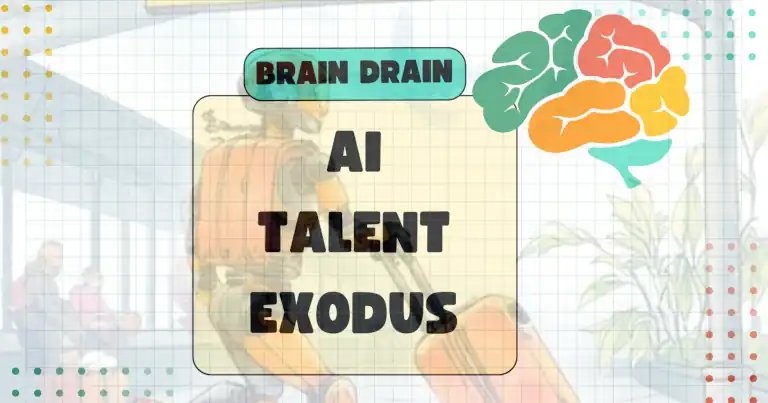
A visual snapshot of the AI Talent Exodus, capturing how India’s brightest minds fade into foreign systems while national capability thins at home.
- The Decoder
- Decision Echoes
Table of Contents
AI Talent Exodus and India’s Strategic Blind Spot
India’s comfort with exporting talent and importing technology has created a structural weakness that now threatens its rise as a technology power. The AI Talent Exodus is not an accident; instead, it is the predictable outcome of decades of policy choices, cultural incentives, and economic narratives that undervalued strategic capability. India must confront the uncomfortable truth that its own mindset, not just foreign pull factors, helped create this vulnerability.
The Remittance Mindset That Traded Talent for Pennies
For nearly four decades, India celebrated the outward flow of engineers, scientists, and researchers because remittances were seen as a national economic victory. This made sense in the 1980s and 1990s, when India was a labor-exporting economy and foreign exchange was scarce. But in the AI era, this mindset is strategically obsolete. Remittances are small, predictable, and low‑value; frontier talent is rare, irreplaceable, and high‑leverage.
The problem is not that Indians went abroad, but the problem is that India built a national narrative that glorified their departure. Families celebrated it. Society rewarded it. Policymakers tolerated it. The result is a culture where losing top talent is normalized, even applauded, while the strategic cost is ignored.
This mindset directly fuels the AI Talent Exodus. When a nation treats its best minds as export commodities rather than national assets, it should not be surprised when they leave. And when those minds leave, India loses not just individuals but entire innovation cycles, research ecosystems, and future industries. Remittances cannot compensate for the loss of sovereign capability, domestic IP, and long‑term technological leverage.
Importing Technology While Neglecting the People Who Could Build It
India spends billions acquiring foreign technology, such as fighter jets, telecom systems, AI tools, and semiconductor equipment, often with restrictions, black‑box limitations, and dependency traps. Yet India invests comparatively little in the individuals capable of building these technologies domestically. This is a strategic contradiction: India pays premium prices for external capability while undervaluing the internal capability that could eliminate those costs.
This imbalance creates a cycle of dependency. When India buys foreign technology, it strengthens foreign ecosystems. When India underinvests in its own talent, it weakens domestic capability. Over time, this creates a structural trap: India becomes a permanent customer rather than a creator.
The deeper issue is cultural. India sees technology as a product to be purchased, not a capability to be built. It sees talent as replaceable labor rather than a strategic asset. It sees foreign systems as safer, more reliable, and more advanced, even when Indian researchers could build sovereign alternatives with the right support.
This mindset ensures that the AI Talent Exodus continues. Why would top researchers stay in a system that values imported hardware more than indigenous human capital? Why would innovators remain in a country that funds procurement more than invention? Until India reverses this imbalance and invests in people with the same seriousness it invests in foreign technology, the exodus will not stop, and India’s strategic blind spot will only deepen.
AI Talent Exodus and the Trap of Foreign Digital Rails
India’s AI rise is happening on top of someone else’s infrastructure. The AI Talent Exodus is no longer just about people leaving; it is about Indian talent, whether abroad or at home, working on foreign‑controlled digital rails that quietly shape, constrain, and expose India’s technological future.
When Infrastructure Becomes a Surveillance Layer on Talent
Even when Indian researchers never leave the country, their work often lives on US‑controlled platforms: cloud providers, code repositories, AI frameworks, and collaboration tools. Every model trained, every dataset accessed, every repository pushed leaves a trail of metadata. The AI Talent Exodus is therefore not only physical but digital. India’s best minds operate inside an ecosystem where foreign powers can map capability simply by owning the pipes.
This visibility is structural, not personal. The system does not need to “target” individuals; it only needs to observe patterns: which domains Indian researchers are active in, what kind of models they train, how quickly they iterate, and what tools they rely on. Over time, this creates a live dashboard of India’s AI trajectory. A country that does not control its digital rails cannot fully control the strategic use of its own talent.
Why Sovereign Compute and Code Infrastructure Are Now Non‑Negotiable
India cannot reverse the AI Talent Exodus while its most capable people are forced to build on foreign foundations. If every serious AI project depends on external clouds, GPUs, repositories, and model hubs, then India is effectively renting its future. Talent may sit in Bengaluru or Hyderabad, but the leverage, data, and insight accumulate elsewhere.
Sovereign AI infrastructure is not a prestige project; it is a survival requirement. India needs national‑scale compute grids, Indian‑owned clouds, domestic code platforms, and secure research networks where frontier work can happen without default exposure. Only then does staying in India become a genuinely strategic option for top researchers.
The message must be clear: India is not just asking its best minds to resist the AI Talent Exodus out of patriotism; it is building the rails that make staying intellectually serious, globally competitive, and strategically meaningful.
The Cost of Building on Borrowed Foundations
India’s technological rise is impressive, but much of it rests on foundations it does not own. This creates a structural fragility that becomes painfully visible in the era of the AI Talent Exodus, where capability is shaped not only by people but by the systems they depend on. When the underlying rails belong to someone else, national ambition becomes constrained by external architecture.
Dependency That Limits Innovation Before It Begins
India’s AI ecosystem is vibrant, but it is also deeply dependent on foreign platforms for compute, code, deployment, and distribution. This dependency is not merely technical; it shapes the very boundaries of what Indian researchers can attempt. When the most advanced GPUs, model‑training environments, and developer tools are controlled by external actors, India’s innovators operate within a permissioned ecosystem.
This creates a quiet but powerful ceiling. Certain experiments become too expensive, too slow, or too restricted. Certain domains, especially those adjacent to national security, become difficult to explore without exposure. The AI Talent Exodus accelerates under these conditions because ambitious researchers naturally gravitate toward environments where infrastructure does not limit imagination. Talent does not leave because it dislikes India; it leaves because the tools required to build the future are more readily available elsewhere.
Over time, this produces a structural imbalance: India generates brilliant minds, but the breakthroughs they create occur on foreign soil, using foreign systems, and strengthening foreign ecosystems.
When Capability Is Rented, Sovereignty Becomes Negotiable
A nation that rents its technological foundations cannot fully control its technological destiny. India’s reliance on external compute, cloud platforms, and AI frameworks means that its most advanced work is mediated through systems it does not govern. This is not a theoretical risk; it is a practical constraint that shapes everything from research velocity to strategic autonomy.
The AI Talent Exodus is amplified by this reality. When researchers see that the most serious work requires foreign infrastructure, they internalize a simple truth: the frontier is elsewhere. And when the frontier is elsewhere, talent follows it.
To break this cycle, India must shift from being a consumer of global infrastructure to a creator of sovereign capability. Only then does staying in India become not just patriotic, but strategically rational.
The Fragmented Pathways That Push Talent Out
India produces extraordinary technical minds, yet the pathways that should guide them into high‑impact national work are fragmented, inconsistent, and often invisible. This structural incoherence quietly accelerates the AI Talent Exodus, not because talent lacks ambition, but because the system fails to convert ambition into opportunity at the right moment.
A System Where Talent Must Navigate Chaos Instead of Capability
In most advanced ecosystems, talent flows through predictable pipelines: undergraduate research tracks, funded labs, industry‑academia bridges, national fellowships, and mission‑driven research clusters. India, by contrast, offers a maze. Students must navigate disconnected institutions, underfunded labs, unpredictable mentorship, and bureaucratic grant systems that reward persistence more than excellence.
This fragmentation creates friction at every stage. A brilliant undergraduate may never meet a serious researcher. A promising PhD candidate may spend more time chasing approvals than running experiments. A young innovator may find no structured path to scale an idea into a national‑level project.
The result is not a lack of talent but a lack of coherent scaffolding. And when the scaffolding is missing, the AI Talent Exodus becomes a rational response. Foreign ecosystems offer clarity, structure, and predictable progression. India offers uncertainty, administrative red tape, and a sense that success depends more on navigating the system than mastering the science.
Talent does not flee chaos out of disloyalty; it flees because chaos is exhausting.
Missed Moments Where India Could Have Captured Its Best Minds
Every nation has inflection points where it either captures its brightest minds or loses them. India repeatedly misses these moments. The transition from undergraduate to research, from research to applied work, and from applied work to national missions is riddled with gaps.
These gaps are not accidental; they are structural. India has no unified national AI research track, no seamless fellowship-to-lab pipeline, and no integrated mission-oriented clusters that attract top talent at scale. Instead, individuals must assemble their own path, often with little guidance and even less institutional support.
This is where the AI Talent Exodus gains momentum. When a researcher sees that their most productive years will be spent fighting for resources rather than advancing ideas, the decision to leave becomes not emotional but logical.
To reverse this, India must build continuous, predictable, high‑velocity pathways that convert raw talent into national capability, not by chance, but by design.
The Hidden Vulnerabilities Built Into Global Mobility
India has long viewed global mobility as an unquestioned good, a path to prosperity, prestige, and opportunity. But in the AI era, mobility comes with structural risks that are rarely acknowledged. The AI Talent Exodus is not only about leaving; it is about entering systems where the rules are written by others, enforced by others, and can be changed without warning. This creates a long‑tail vulnerability for Indian talent that India has never prepared for.
The American Trap and the Illusion of Long‑Term Security
For decades, Indian professionals believed that once they entered the American system, whether through H‑1B, O‑1, F‑1, or research pathways, their future was secure. But the reality is more complex. The American Trap is not a conspiracy; it is a structural dynamic: individuals spend their prime productive years within a system that extracts maximum value from their expertise, yet offers no guarantee of permanence.
Even without a visa denial or deportation, many find themselves pushed out after their peak years, when their utility to the system declines. And when they return to India, they face a new problem: if they worked in sensitive AI domains, they may encounter employment restrictions, export‑control limitations, or compliance barriers that follow them home.
The AI Talent Exodus thus creates a paradox. India loses its best minds during their most valuable years, and when they return, they are often constrained from contributing fully.
When Technology Becomes a Monitoring Layer, and Sanctions Become Personal
The deeper vulnerability is that Indian researchers, even without visas, operate within American technological ecosystems, including cloud platforms, AI frameworks, chip‑cloud APIs, and developer tools. This provides visibility into their work, networks, and expertise. It is not espionage; it is simply how digital infrastructure functions.
In extreme cases, individuals working in sensitive domains may face personal sanctions if they violate or fail to comply with exit‑control obligations. They may be subject to restrictions on access to the dollar system (SWIFT), limits on collaboration with global institutions, or exclusion from international techno‑circles. These measures are rare but real, and they demonstrate how dependence on foreign systems can translate into individual‑level vulnerability.
A real‑world illustration of such punitive outcomes can be seen in the case of certain Iranian scientists who, despite never working in the United States, face similar restrictions because their digital activities occurred on American‑controlled technological platforms that are routinely monitored for compliance.
This is the unspoken dimension of the AI Talent Exodus: when a nation does not control the rails its talent runs on, its people remain exposed long after they leave, and sometimes even after they return.
The Global Hierarchies That Shape India’s AI Trajectory
India’s rise in AI is occurring inside a global system where power is unevenly distributed, rules are externally defined, and capability is shaped by access rather than ambition. These hierarchies quietly influence how Indian talent moves, what it can work on, and how the AI Talent Exodus accelerates when domestic structures fail to counterbalance external pressures.
How the AI Talent Exodus Reinforces Global Asymmetry
The AI Talent Exodus does not merely relocate individuals; it redistributes capability into ecosystems that already dominate the global AI landscape. When India’s best minds move into foreign labs, cloud platforms, and research clusters, they strengthen systems that are already structurally advantaged. This creates a reinforcing loop: the more talent flows outward, the more powerful those ecosystems become, and the more attractive they appear to the next generation of Indian researchers.
This asymmetry is not accidental. Frontier AI work requires compute, capital, and institutional depth, all of which are concentrated in a handful of countries. India’s innovators often find that the most advanced problems, tools, and collaborators exist outside its borders. The result is a gravitational pull that intensifies the AI Talent Exodus, not because India lacks ambition, but because global hierarchies reward proximity to power.
Over time, this dynamic shapes India’s strategic position. The breakthroughs created by Indian minds strengthen foreign institutions, foreign companies, and foreign national capabilities. India becomes a producer of talent but a consumer of outcomes, a structural imbalance that no nation can sustain indefinitely.
When Global Gatekeepers Decide Who Gets to Build the Future
The world’s most influential AI institutions, from cloud providers to chip manufacturers to research consortia, act as gatekeepers. They determine who receives access to advanced computing, who can join high‑impact collaborations, and who is permitted to work on sensitive domains. These decisions are not neutral; they reflect geopolitical priorities, export‑control regimes, and national‑security considerations.
For Indian researchers, this creates a dual vulnerability. First, access to frontier tools is conditional, revocable, and often mediated through compliance frameworks that India does not control. Second, the pathways to global influence are shaped by institutions that can restrict participation without explanation.
This environment accelerates the AI Talent Exodus because talent seeks places where gatekeeping is minimized and opportunity is maximized. Yet it also exposes Indian researchers to long‑term risk: the same systems that enable their rise can later restrict their work, limit their collaborations, or impose compliance obligations that follow them across borders.
To break this dependency, India must build institutions that are not merely participants in the global hierarchy but creators of new ones. Such institutions that attract talent not because foreign systems rejected them, but because India offers a frontier of its own.
The Policy Levers India Must Use to Reclaim Strategic Talent
India cannot reverse the structural forces driving the AI Talent Exodus through sentiment, speeches, or soft incentives alone. Nations that protect their strategic talent use a calibrated mix of deterrence, obligation, and opportunity. India must now adopt the same clarity. The goal is not to restrict freedom but to align national investment with national return, a principle every major power already follows.
The Stick: Aligning Public Investment With Public Obligation
India spends decades and significant public resources educating its top technical minds, yet receives little strategic return when those minds immediately join foreign systems. To correct this imbalance, India must introduce emigration‑linked obligations for individuals who benefited from subsidized education.
A calibrated Emigration Contribution Tax for graduates of premier Indian institutions who depart to work on H‑1B or equivalent visas would not be punitive; it would simply ensure that public investment is not converted into foreign strategic advantage at zero cost. This is standard practice in multiple countries that treat talent as a national asset rather than an export commodity.
Similarly, students who draw on foreign exchange to study abroad should execute return‑linked bonds. If they do not re‑enter the Indian tax system within a defined period, the bond is encashed. This is not coercion; rather, it is reciprocity. India is not asking for loyalty; it is asking for accountability.
These measures also counter a key driver of the AI Talent Exodus: the perception that India bears the cost while others reap the benefit. When obligations are formalized, the system becomes fairer, clearer, and strategically aligned.
The Carrot: Making India the Most Rational Place to Build the Future
Deterrence alone cannot reverse the AI Talent Exodus. India must simultaneously create a domestic environment where the best opportunities exist at home: sovereign compute grids, elite AI research tracks, mission‑driven labs, and compensation structures that rival global benchmarks.
When India offers frontier‑level work, world‑class infrastructure, and predictable career pathways, the decision to stay becomes not patriotic but rational. The carrot is simple: India must become the place where ambitious minds can do the most ambitious work.
A nation that combines obligation with opportunity does not trap talent; it retains it.
How the AI Talent Exodus Shapes National Futures and Demographic Power
India is not alone in confronting the strategic consequences of losing its brightest minds. Across the world, nations are discovering that talent flows reshape geopolitics as profoundly as trade routes or military alliances. The AI Talent Exodus is therefore not merely an Indian challenge; it is a global reordering of capability, demography, and long‑term national strength.
Lessons From Europe’s Talent Vacuum and Ukraine’s Demographic Shock
Europe’s struggle with aging populations and shrinking workforces has already forced it to rely heavily on imported talent. The analysis in Brain Drain: How the Exodus of Talent Is Redefining the Map of Europe shows how entire regions are being hollowed out as young, educated workers move westward, leaving behind structurally weakened economies.
Ukraine is the most dramatic example of this phenomenon. The war accelerated a massive outflow of young, educated Ukrainians, many fleeing conscription, many simply seeking stability. The EU rapidly integrated them to offset its own demographic decline, gaining a young workforce at precisely the moment Ukraine needed it most.
For Ukraine, this is a generational loss: the very people required to rebuild the nation are now embedded in European economies. For the EU, it is a demographic windfall. For Ukraine, it is a demographic wound.
This is the geopolitical logic of talent flows. Capability moves toward stability, and instability pays the price.
Why India Must Treat Talent as a Strategic Asset, Not a By‑Product
India cannot afford a similar fate. The AI Talent Exodus drains not only capability but future demographic strength. When top researchers, engineers, and innovators leave during their most productive years, the loss compounds across decades: fewer founders, fewer labs, fewer breakthroughs, fewer national missions.
India must therefore treat talent as a strategic resource, not a by‑product of its education system. Nations that fail to protect their talent lose more than people. They lose the future that those people would have built.
India stands at a decisive moment. The AI Talent Exodus is not simply a story of individuals seeking opportunity abroad; it is a structural drain on national capability, demographic strength, and long‑term technological sovereignty. Nations that fail to protect their talent lose more than skilled workers; they lose the future those workers would have built. Europe’s demographic vacuum, Ukraine’s wartime outflow, and the rapid absorption of young talent into foreign systems all show how quickly capability can migrate and how slowly it returns.
India must choose differently. By combining obligation with opportunity, deterrence with ambition, and sovereign infrastructure with world‑class pathways, India can transform its talent from a global export into a national engine. The question is no longer whether India can afford to act; it is whether India can afford not to.