
The Latency Paradox is the idea that AI systems often slow down for unexpected reasons. Slowdowns come from hidden coordination problems, unseen safety checks, and missed choices about systems that build up and are noticed by users. Spotting these problems is key to making AI feel fast instead of slow or unintelligent.
Latency Paradox: 3 Dangerous Bottlenecks You Missed
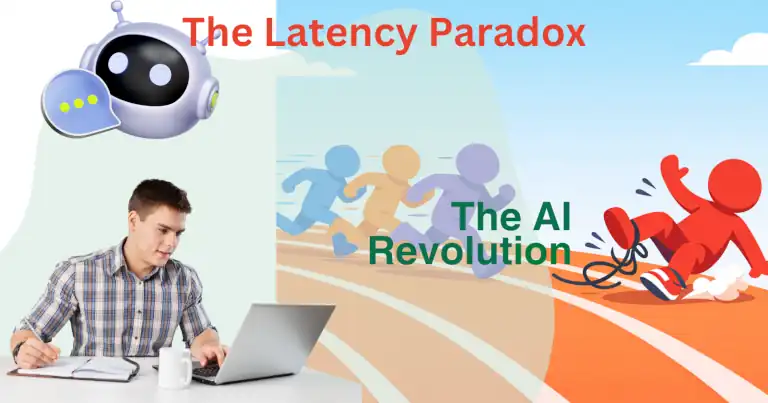
Even in a seamless sprint, one stumble defines the memory. The latency paradox lives in the moment the users feel hesitation.
- The Decoder
- Latency Logs
- June 12, 2026
Table of Contents
Ignoring the Hidden Costs Behind the Latency Paradox
Most AI teams underestimate how deeply the latency paradox shapes user perception. They assume latency is a technical nuisance, something to be “optimized later” once the model is stable. But latency is not a backend metric; it is a frontline experience. Every millisecond of delay compounds into cognitive friction, erodes trust, and makes the system feel less intelligent than it actually is. The paradox arises because the model isn’t always the problem. The real slowdown lives in the orchestration layers, dependency chains, guardrails, and silent system behaviors that no one audits until performance collapses under real‑world load. This mistake persists because teams optimize what is visible, such as the model, and ignore what is structural: the system wrapped around it.
The Latency Paradox in Orchestration Layers
Orchestration exposes the latency paradox most clearly and often misunderstood. Modern AI systems use complex chains of microservices, prompt routers, retrieval layers, and post-processing steps. Each component adds seemingly minor delays, but combined, they create drag that exceeds the model’s inference time. A 150-ms model call can inflate to a 1.2-second response when stitched together with inefficient hops.
The deeper issue is that orchestration layers evolve organically rather than intentionally. Teams add services, checks, routing logic, and fallback paths without revisiting architecture. Over time, the system becomes a patchwork of synchronous calls posing as asynchronous flows. Logging frameworks add overhead. Monitoring tools add overhead. Even token streaming, meant to improve perceived speed, can cause delays if poorly implemented.
This is the latency paradox: as the system grows more “intelligent” through additional layers, it slows down. The orchestration layer becomes a silent tax on intelligence, and because it’s invisible to dashboards, teams only notice the speed loss when users complain.
Hidden Dependencies That Quietly Slow Everything
Dependencies are the dark matter of AI latency. They shape everything, yet are largely unseen. A single slow API call, misconfigured database index, or minor third-party degradation can throttle the entire system. These dependencies often sit outside the AI team’s control, making them even more dangerous.
The latency paradox shows up here in subtle ways. A dependency that adds only 80–100 ms of delay may seem harmless in isolation. But when multiplied across multiple calls, such as retrieval, validation, enrichment, and logging, the total delay becomes significant. Worse, many systems include silent retries that mask failures until traffic spikes. Under load, these retries multiply, turning a minor slowdown into a cascading failure.
Vector databases are another overlooked dependency. Teams assume vector search is always fast, but performance varies by index type, shard distribution, hardware, and query complexity. A poorly tuned vector DB can add hundreds of milliseconds to each request, and because it “works,” no one questions it.
Dependencies also introduce variability, such as latency jitter, which is often more damaging than raw delay. Users can tolerate a consistent 800 ms response. They cannot tolerate a system that sometimes responds in 200 ms and sometimes in 2 seconds. Variability breaks trust faster than slowness.
Over‑Engineered Guardrails That Backfire
Not only are guardrails essential for safety, compliance, and brand protection, but they are also one of the most common sources of hidden latency. The latency paradox becomes painfully clear when teams stack multiple guardrail layers without considering their cumulative cost. Content filters, toxicity checks, hallucination detectors, policy validators, and post‑processing classifiers all add processing time. When these layers run sequentially, they can double or triple the total response time.
The problem isn’t the guardrails, but the architecture. Many teams build guardrails as blocking steps rather than parallel checks. Others use heavyweight models for tasks that lightweight heuristics or embeddings could handle. Some systems run guardrails before and after generation, resulting in redundant work and increased latency.
Guardrails often operate on full outputs rather than token streams, forcing the system to wait for the full response before validation and negating the benefits of streaming speed. In extreme cases, guardrails force the system to regenerate outputs multiple times, compounding latency.
The result is a system that feels cautious, slow, and unintelligent, not just because the model is weak, but because the safety architecture is inefficient. The latency paradox strikes again: the more you attempt to protect the user, the more the system feels broken.
Treating Latency as a Purely Technical Problem Instead of a Product Reality
One of the most damaging misconceptions in AI teams is the belief that latency is something engineers fix “under the hood” while product teams focus on UX, features, and user journeys. This separation is artificial and costly. Latency is not a backend concern; it is a product experience that shapes how users perceive intelligence, reliability, and trust. When teams treat latency as a technical afterthought, they miss the deeper behavioral and emotional consequences that define whether an AI system feels magical or mediocre. The real danger is that latency accumulates silently, with users feeling the slowdown long before dashboards reveal it. This disconnect between perception and measurement is why latency becomes a strategic blind spot rather than a technical metric.
How the Latency Paradox Distorts User Perception
The latency paradox becomes especially visible when you examine how users interpret delays. A system that responds in under 300 ms feels instant, intuitive, and intelligent. But once responses cross the one‑second mark, users begin to question the system’s competence even if the underlying model is state‑of‑the‑art. This perception gap is rarely understood by engineering teams because they measure latency in milliseconds, while users measure it in emotional friction.
A delay of 700–900 ms may seem acceptable on a dashboard, but to a user, it feels like hesitation. That hesitation is interpreted as uncertainty, confusion, or lack of capability. The paradox is that even small delays can make a powerful model feel weak, while a fast system can make a modest model feel brilliant. This is why latency must be treated as a product‑level priority: it directly shapes the user’s mental model of the AI’s intelligence.
Another overlooked dimension is interaction rhythm. Users develop an internal cadence when interacting with AI systems. If the system breaks that rhythm even slightly, the entire experience feels off. This is why latency is not just about speed; it’s about maintaining a consistent, predictable tempo that reinforces trust.
Why Product Teams Underestimate Latency’s Impact
Product teams often focus on features, flows, and UI polish, assuming that performance tuning will happen later in the development cycle. But latency is not a layer you optimize at the end; it is a foundational constraint that shapes what the product can be. When latency is ignored early, teams build features that look good in prototypes but collapse under real usage.
One reason product teams underestimate latency is that internal demos are misleading. In controlled environments, with clean inputs and minimal load, the system appears fast. But real users introduce variability, including longer queries, ambiguous prompts, edge cases, and unpredictable traffic patterns. These real‑world conditions expose latency behaviors that never appear in internal testing.
Another issue is that product roadmaps rarely include explicit latency goals. Teams define features, deadlines, and KPIs, but they rarely define experience thresholds such as “responses must stream within 200 ms” or “full outputs must complete within 1.2 seconds.” Without these constraints, latency becomes a reactive problem rather than a proactive design principle.
This leads to a dangerous cycle: product teams ship features that feel slow, users disengage, and engineering teams scramble to optimize a system that was never designed for speed in the first place.
The Emotional Cost of Latency on User Trust
Latency doesn’t just slow down interactions, but it erodes trust. When an AI system hesitates, users subconsciously interpret that hesitation as uncertainty or incompetence. This emotional response is powerful and often irreversible. A user who experiences slow responses early in their journey will assume the system is unreliable, even after performance improves.
The emotional cost is amplified in high‑stakes or high‑frequency use cases. In customer support, a slow response feels like poor service. In creative tools, it breaks the flow. In productivity apps, it feels like friction. In decision‑support systems, it feels like risk. The same delay can have dramatically different emotional impacts depending on context, which is why latency must be understood through a product lens, not just a technical one.
Another subtle effect is anticipatory frustration. Once users experience latency a few times, they begin to expect it. This expectation changes their behavior, leading them to type shorter prompts, avoid complex tasks, or abandon the system entirely. The system becomes self‑limiting because users no longer trust it to handle anything demanding.
This is why latency must be treated as a core product attribute. It shapes not only the user’s immediate experience but also their long‑term relationship with the system.
Building AI Systems Without a Real Latency Budget
AI teams often pour enormous effort into model selection, prompt engineering, and feature development, yet operate without a clear, enforceable latency budget. This is one of the most expensive strategic mistakes because it allows delays to accumulate invisibly across the system. A latency budget is not a technical document; it is a product contract that defines the emotional threshold of acceptable delay. Without it, teams make decisions that feel harmless in isolation but catastrophic in combination.
“Delay is the deadliest form of denial.”
C. Northcote Parkinson, a naval historian famous for Parkinson’s Law
In AI systems, this denial manifests as the slow, silent buildup of friction that users interpret as incompetence. The absence of a latency budget is where the latency paradox becomes a self‑inflicted wound.
When Teams Ship Features Without Latency Constraints
Most AI features are designed around capability, not speed. Teams ask, “Can we do this?” instead of “Can we do this within 800 ms?” This mindset creates a dangerous blind spot. A feature that works beautifully in isolation may become unusable when combined with real‑world load, retrieval steps, guardrails, and post‑processing. Without a latency budget, every team assumes someone else is responsible for performance. The product assumes engineering will optimize later. Engineering assumes infra will scale. Infra assumes the product will define limits. The result is a system where no one owns the experience.
This is where the latency paradox becomes painfully visible: the more features you add, the slower the system becomes, even if each feature is individually efficient. A latency budget forces teams to confront trade‑offs early. It clarifies what is acceptable, what is negotiable, and what must be redesigned. Without it, teams ship features that feel impressive in demos but frustrating in production.
The Hidden Drift That Destroys Performance Over Time
Latency drift is one of the most underestimated threats in AI systems. Even if a system launches with excellent performance, it rarely stays that way. New logging layers, additional safety checks, expanded retrieval pipelines, and increased traffic all introduce incremental delays. Each delay is small enough to ignore, but together they accumulate into a noticeable slowdown. This drift is rarely tracked because teams measure latency at the model level rather than the system level.
The latency paradox shows up here in a subtle but damaging way: improvements meant to enhance reliability or safety often degrade speed. A new guardrail adds 40 ms. A new analytics hook adds 20 ms. A new retrieval step adds 60 ms. None of these changes trigger alarms individually, but collectively they push the system past the threshold where users perceive hesitation. Without a latency budget, drift becomes inevitable because no one is accountable for the cumulative effect.
A well‑defined latency budget acts as a governor. It forces teams to justify every new millisecond. It also ensures that performance is treated as a living constraint, not a one‑time optimization task. Without this discipline, latency becomes a slow‑moving failure that only surfaces when user trust has already eroded.
Why Latency Budgets Fail Without Cross‑Team Ownership
Even when organizations attempt to create latency budgets, they often fail because they treat them as engineering documents rather than cross‑functional commitments. A latency budget must be owned jointly by product, engineering, infra, and design. If any one of these groups opts out, the budget collapses. The product must define the emotional thresholds. Engineering must enforce architectural constraints. Infra must ensure scalability. Design must shape user expectations through interaction patterns.
The latency paradox becomes especially dangerous when ownership is fragmented. If product teams push for richer features without considering performance, latency rises. If engineering teams optimize only the model and ignore the pipeline, latency rises. If infra teams scale hardware but ignore orchestration inefficiencies, latency rises. A latency budget works only when every team understands that speed is not a luxury; rather, it is a core part of the user experience.
A strong latency budget also includes worst‑case scenarios, not just averages. Users don’t care about your P50. They feel your P95. They remember your P99. A system that is fast most of the time but slow occasionally still feels unreliable. This is why latency budgets must be written around the highest tolerable delay, not the most common one.
Synthesis Layer: Where Latency Becomes Strategy
The deeper you examine modern AI systems, the clearer it becomes that performance is not a by‑product of infrastructure but a direct expression of architectural intent. The latency paradox forces teams to confront an uncomfortable truth: speed is not merely an engineering metric but a product behaviour that shapes trust, adoption, and perceived intelligence. Systems that ignore this reality drift toward inconsistency, while systems built with explicit latency budgets evolve into reliable, high‑confidence tools.
For teams looking to benchmark their thinking against broader industry patterns, resources like the latency‑focused research at What is latency? | How to fix latency provide a useful grounding in how foundational network delays shape system behaviour. For a practical, real‑world example of how latency behaviours escalate into user‑visible failures, the analysis in Latency Protocols 25: When AI Loops Trap Real Help shows how subtle system delays can compound into breakdowns in user trust.
Why Latency Discipline Determines Long‑Term AI Credibility
Latency is ultimately a proxy for organizational clarity. Teams that treat speed as a first‑class design constraint build systems that feel confident, predictable, and intelligent. Teams that treat latency as an afterthought accumulate invisible friction until users lose trust. The organizations that win are those that treat latency as a design discipline, because it determines whether AI delivers seamless intelligence or exposes the hesitation that defines the latency paradox.